AIEO vs SEO: I Know It Sounds Like Splitting Hairs, But the Difference Is Significant
Every time a new acronym enters the SEO space, there’s a reasonable amount of skepticism about whether it represents something genuinely new or just old work with a fresh label. That skepticism is healthy and earned. The industry has a history of rebranding existing practices as new disciplines whenever the marketing moment calls for it.
So when Artificial Intelligence Experience Optimization, AIEO, started appearing alongside traditional SEO in strategy conversations, it made sense to be cautious. Is this a real distinction? Does it require different work? Or is it conventional SEO with an AI-themed veneer?
Having spent meaningful time with both disciplines in practice, the honest answer is: the distinction is real, it matters in specific and important ways, and the two need to coexist rather than compete in a modern search strategy. But the overlap is also significant, and anyone positioning them as entirely separate disciplines is probably oversimplifying for marketing purposes.
Here’s what’s actually different.
The Shared Foundation
Both SEO and AIEO are ultimately about making content discoverable and useful in search contexts. Both depend on content quality, technical site health, and authority signals. Both care about structured data, page speed, and clear content organization. Neither works well without the other’s foundation.
A site with weak traditional SEO, poor technical health, low domain authority, thin content, is not going to perform well in AI-generated search responses regardless of how specifically it’s optimized for AIEO. The AI systems that power AI Overviews and conversational search draw on much of the same quality signal infrastructure that traditional search ranking uses.
So AIEO is not a replacement for SEO. Anyone positioning it that way is either confused or selling something.
Where AIEO Is Genuinely Different
The optimization targets diverge meaningfully when you get to specific objectives.
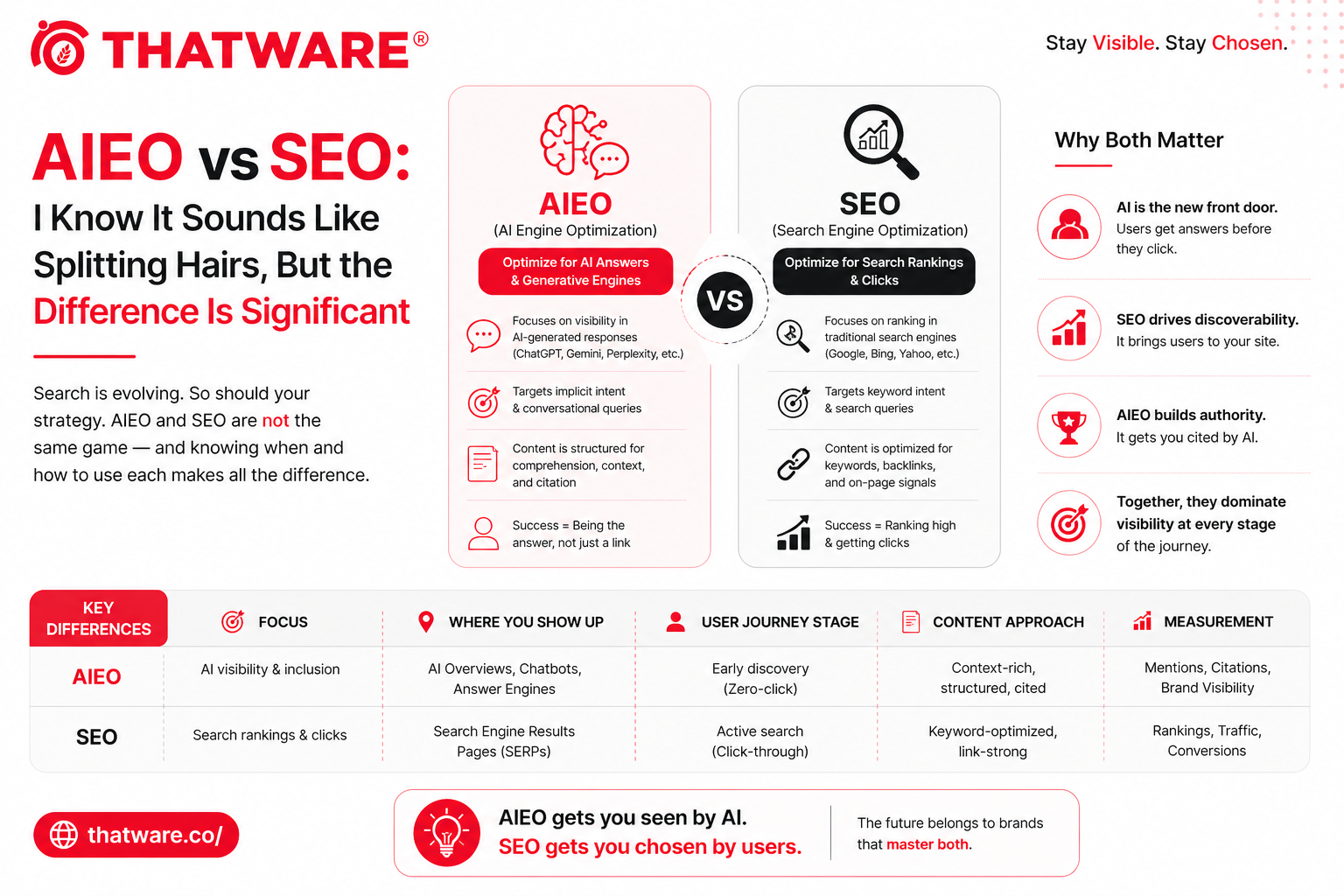
Traditional SEO optimizes for position in a ranked list of results. The primary question is: which position does this page hold for this query? The primary metric is ranking position, and the secondary metrics are click-through rate and traffic from that position.
Aieo services optimize for inclusion in AI-synthesized responses. The primary question is: is this content being cited in AI-generated answers for relevant queries? The primary metric is AI citation frequency, and the secondary metrics are how the brand and content are represented in those citations.
These are different questions requiring partially different approaches.
For AI citation optimization, content clarity and extractability matter more. AI systems need to be able to extract specific, useful information from content to include it in a synthesized answer. Dense, nuanced prose that reads well as a continuous piece may not extract cleanly. Content that makes key points clearly and explicitly, even if it’s slightly less elegant as pure writing, often extracts better.
Entity authority matters more for AI citation than for traditional ranking in some respects. Traditional ranking is heavily influenced by link authority at the page and domain level. AI citation is more influenced by how well the brand is recognized as an authoritative entity on the specific topic, which is built through consistent mention in relevant contexts across credible sources, not just through link building.
The Format Difference
Ai search optimization services also require thinking about content format differently than traditional SEO.
Traditional SEO content is formatted for human reading, with SEO signals layered in. Long-form content that covers a topic thoroughly, with internal heading structure and relevant keyword usage, has been the standard model for competitive content.
AI citation optimization doesn’t always reward length. It rewards precision and specificity. A page that clearly and specifically answers a narrow question is more likely to get cited for that question than a comprehensive guide that covers the question among many others. Both have their place, but the content strategy decisions are different.
This has implications for how content libraries are structured. A mix of comprehensive pillar content and highly specific, targeted pieces that each answer a narrow question with precision tends to outperform a content library of only comprehensive guides for AI citation purposes.
Measurement Is the Practical Dividing Line
Here’s where the practical difference becomes most concrete. You measure SEO performance and AIEO performance differently, using different tools and different tracking methodologies.
SEO performance: rank tracking software, organic traffic via Google Analytics, Google Search Console data on impressions and clicks.
AIEO performance: manual audit of AI-generated responses for target queries, emerging AI visibility tracking tools, brand mention monitoring across AI-generated content, Google Search Console data specifically on AI Overview interactions.
Running an SEO program without AIEO measurement misses the AI visibility dimension entirely. Running an AIEO program without traditional SEO measurement misses the organic ranking dimension. The complete picture requires both.
The Practical Recommendation
For most businesses, the right framing is that AIEO is an additional layer on top of a solid SEO foundation, not an alternative to one. The additional work AIEO requires, entity authority building, content clarity optimization for AI extraction, AI visibility monitoring, adds to a well-functioning SEO program rather than replacing any part of it.
The prioritization question is real. Businesses with limited resources need to make choices. For those, the hierarchy is clear: get the SEO foundation right first, then add AIEO optimization as resources allow. For businesses with more mature SEO programs, adding AIEO to the mix now is worth doing while the competitive pressure to do so is still modest.
The distinction between SEO and AIEO is real, and it matters. But the smartest approach treats them as complementary rather than competing.